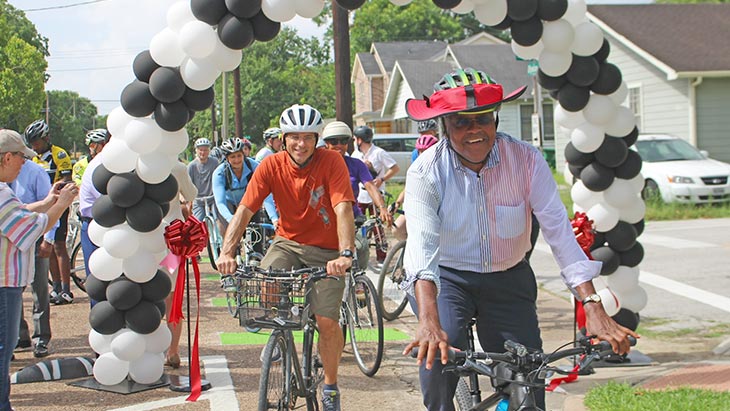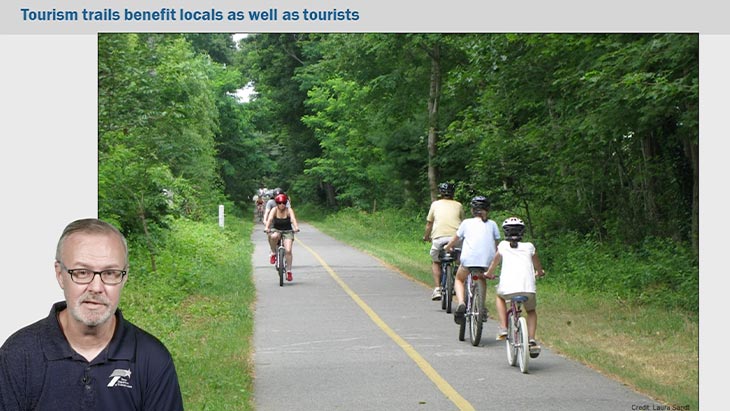
This talk provides a retrospective overview of trends in walking and cycling levels, safety, funding, research, and infrastructure over the past three decades. It portrays significant progress in most areas from 1990 to 2020, but with some ups and downs. Walking for all trip purposes in total has increased significantly as a modal share of trips, while the increase in cycling mode share has only slightly increased. Funding for walking and cycling facilities and programs has skyrocketed since 1990, largely due to large increases in federal funding.
That has enabled tremendous expansion in the extent of walking and cycling facilities and improvements in their design quality, connectivity, and maintenance. For example, on-street bike lanes–especially protected bike lanes–wider sidewalks, and mixed-use off-road trails and greenways have increased about 10-fold since 1990.
Academic research on walking and cycling issues has boomed since 1990, increasing 70-fold, greatly enriching the professional knowledge and awareness of professional transportation planners and engineers. That has helped integrate walking and cycling into the overall transportation system, so that walking and cycling are now routinely included in most urban and metropolitan transportation plans.
In many American cities, roads are now being transformed into complete streets, with provisions not only for motor vehicles, but for pedestrians and cyclists as well. Although there have been major improvements in walking and cycling since 1990, much more needs to be done to increase their safety and convenience.
Identification of Need: Understanding long-term trends in walking and cycling from 1990-2020 in the USA including international comparison.
Learning Objectives:
- View graphical depictions of key trends in walking and cycling from 1990-2020.
- Consider both the progress made over the past 3 decades as well as crucial needs that still remain.
- Get a truly international context from which to evaluate walking and cycling trends in the USA, comparing progress here to other countries.
Learner Assessment Statement: Understand walking and cycling trends and their importance in infrastructure planning.